2025 Volkswagen Tiguan: Successful Inner Work

Brands who sell vehicles in North American give much more attention to their SUVs than their cars during their life cycles. It’s easy: they're the ones that bring in the cash. But this can quickly become a double-edged sword for those brands with a rich performance heritage. On the one hand, it's all about profit, but on the other, it's easy to dilute the brand's DNA and render it insipid in the eyes of purists.
On a global scale, the Tiguan is Volkswagen's best-selling product. As part of its third generation, the Tiguan has been given a new, more muscular look - in line with the segment trend - including a higher hood, a new front fascia and a sloping roofline at the rear. But it’s inside that the Tiguan gets the bulk of its changes.
- Also: Volkswagen to Launch Two Hybrids in North America in Coming Years
- Also: 2025 Volkswagen Tiguan Goes on Sale This Spring With Higher Prices
The Car Guide travelled to Montana to test drive the Volkswagen Tiguan 2025.

Adequate Performance, German Precision
The Tiguan's platform remains essentially untouched for this new generation, apart from a few recalibrations to the suspension and steering. The only available drivetrain option, the 2.0-litre turbocharged 4-cylinder, receives 17 additional horsepower for a total of 201, while torque remains unchanged at 221 lb-ft.
This engine is mated to an eight-speed automatic transmission and standard 4MOTION all-wheel drive system across all versions.
The finesse, precision and ride comfort of the Tiguan are finally back for this 2025 model. The engine's power is sufficient for everyday driving, with a responsive accelerator feel during city driving. However, when the Tiguan is put to greater use at higher speeds, the transmission shows shortcomings in terms of response, notably with delays when downshifting. This can put a damper on drivers looking for a spicier drive. Switching the drive mode selector does little to alleviate this rather unfortunate symptom. Otherwise, steering feedback is good and braking is as precise as ever.
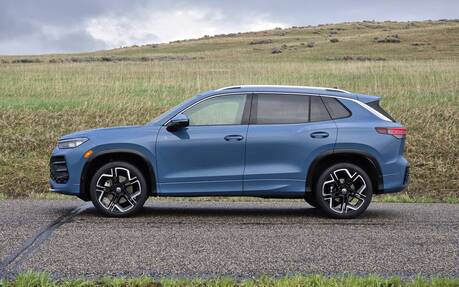
Fuel consumption averaged a combined 8.9 L/100 km during our test drive. But it’s worth considering that we drove around at an altitude of 5,000 feet in the mountains of Montana, in near-freezing weather. A proper test in Quebec will confirm whether the Tiguan has improved in this respect.
Spectacular Transformation Inside, With One Less Option
Volkswagen interiors have long been praised for their superior quality of finish and materials. Somewhere in the middle of the last decade, however, this reality was compromised by rather insipid choices of materials and layouts throughout the product line, but especially in SUVs. The new Tiguan seems intent on redeeming itself with an environment that can easily be described as premium.
For one thing, Volkswagen has opted for comfortable, supportive upholstery, whatever the model. There's also generous legroom for second-row passengers.
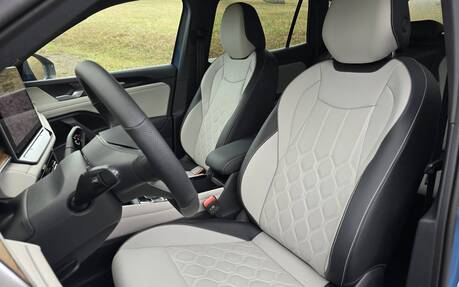
Next, the dashboard has been completely redesigned. Good-quality materials and textures have been chosen, and several key elements have been relocated. The gearshift lever has been replaced by an arm on the steering column. Whether you like the way it works or not, this move has freed up an impressive amount of space in the centre console, including a 7.6-litre “hole” between the two passengers. Not far from this is a new multifunction rotary knob which not only controls the audio system volume, but can also switch between the various drive modes.
Another analog addition we appreciated was the replacement of the touch controls on the steering wheel with buttons that are easier to use and clean. The shape, and especially the grip provided by this small steering wheel, is also commendable for sporty driving enthusiasts.

In terms of infotainment, the top Highline R-Line variant we tested was equipped with a voluminous 15-inch screen. While this proved easy to use, its predominance can take some getting used to, especially in terms of distractions on the road. The base screen on all other models spans 12.9 inches, providing ample surface area to interact with the interface. But what stands out most in the cabin is what you can't see or hear. The cabin's insulation seems to have been reworked, literally offering a haven of peace worthy of a luxury car on the road.
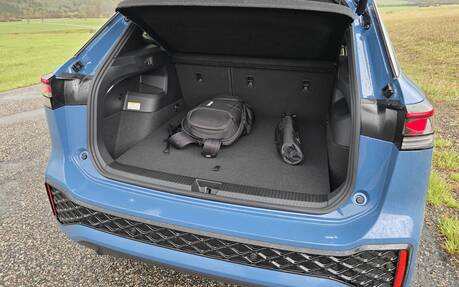
The Tiguan enters its 3rd generation with one less option: the third row, which was available on the outgoing model. According to Volkswagen, only 10% of buyers ordered this equipment, so removing it from the catalogue was a no-brainer. The manufacturer also expects the new Tiguan's plunging rear roof line to cut a few litres of cargo space, without being able to just yet confirm the exact space available there.
A New Powertrain on the Way
Volkswagen argues that its first-generation Tiguan compromised too much on utility in favour of sportiness, while the second did the opposite. The brand claims that this third generation represents a balance between the two. Whether or not we agree with this statement, the Tiguan is a well-equipped compact SUV, which is now better finished inside, with a more chic and intuitive feel to the controls.
As for the engine, while the 4-cylinder does the job in most scenarios, we're still hungry for performance and hybridization, both of which could greatly benefit the Tiguan.

For the former, a new drivetrain option will be added to the catalogue in 2026. We’re talking about a recalibrated version of the turbocharged 4-cylinder engine with a 268-hp output standard on the range-topping model. As for the second component, plans for the Tiguan's hybridization have yet to be revealed.
Pricing-wise, the base Trendline model starts the ball rolling at $34,495 plus $2,200 preparation and delivery charges. At the other end of the spectrum, the Highline R-Line variant carries a price tag of $47,495 plus $2,200 preparation and delivery charges.
VIDEO: Volkswagen unveils the 2025 Tiguan
| Test drive report | |
| Test model | 2025 Volkswagen Tiguan |
|---|---|
| Trim level | Highline R-Line |
| Price range | $36,495 – $47,495 |
| Price as tested | 47 495 $ |
| Warranty (basic) | 4 years/80,000 km |
| Warranty (powertrain) | 5 years/100,000 km |
| Fuel economy (city/highway/observed) | 10,5 / 7,8 / N/A L/100km |
| Options | N/A |
| Competitive models | Chevrolet Equinox, Ford Bronco Sport, Ford Escape, GMC Terrain, Honda CR-V, Hyundai Tucson, Jeep Compass, Kia Sportage, Mazda CX-5, Mazda CX-50, Mitsubishi Outlander, Nissan Rogue, Subaru Forester, Toyota RAV4 |
| Strong points |
|
| Weak points |
|
| Editor's rating | |
| Fuel economy | With an observed fuel consumption of 8.9 L/100 km in less than ideal conditions, we'll need to do more tests to confirm the new Tiguan's improved frugality. |
| Comfort | Comfortable seats, super-quiet interior, the Tiguan plays the luxury SUV game very well in this department. |
| Performance | The Tiguan's enhanced power output is hardly noticeable. |
| Infotainment | If the 15-inch screen in the Highline R-Line model is unnecessarily large, the standard 12.9-inch screen is more than adequate. Volkswagen has also added manual controls to complement it. |
| Driving | Precise and agile, the Tiguan rewards the driver with good dynamics at the wheel. |
| Overall | Once a high-performance model and a hybrid version are added to the catalog, the Tiguan will be a serious threat in the segment. |