2026 Honda Civic Hatchback: An Overlooked Star?
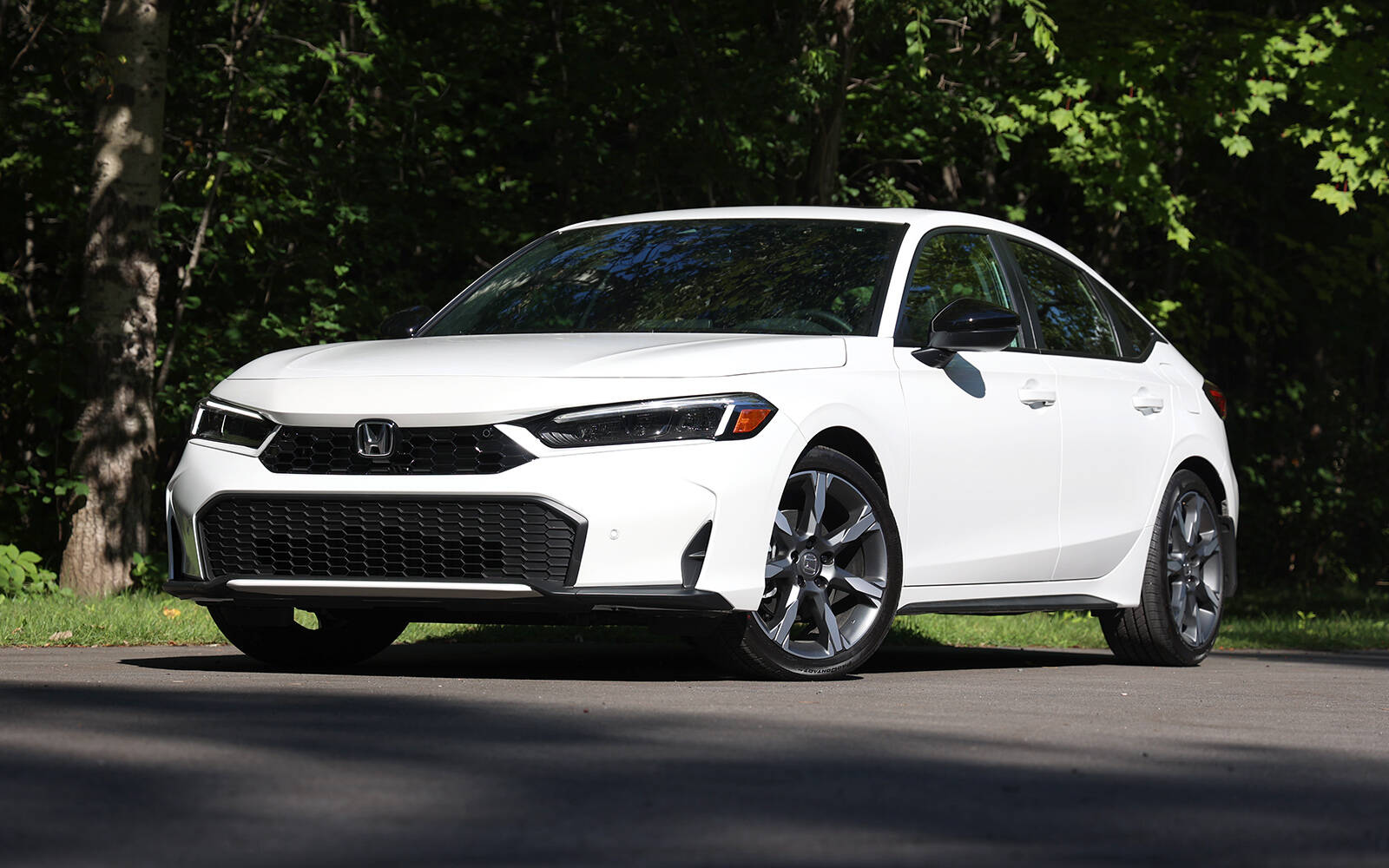
The Honda Civic Hatchback made a return to Canada with the previous generation as a 2017 model, but it stopped being the cheap compact car it used to be a couple of decades ago. Essentially, it became the sedan’s more upscale twin.
Unlike the locally built four-door Civic that Honda Canada is so proud about, the hatchback was manufactured in the U.K. before production moved to the U.S. with the current generation. It’s now enjoying more success, although not quite as much as the sedan, which makes us question the automaker’s real intention. How much did it want to gain market share with the hatchback, and how obsessed with the sedan will it continue to be?
- Also: Top 10 Most Affordable Hybrid Vehicles in 2025
- Also: Top 10 Best-Selling Vehicles in Canada, First Half of 2025

11 Percent
Last year, the Civic Hatchback accounted for just 11 percent of Civic sales in the country, with 3,495 units out of a total of 31,774. Consider this: Volkswagen actually sold more Golf GTI and Golf R units during the same period. Of course, these German hot hatches are not aimed at the same crowd, but clearly there’s a case to be made for a five-door Civic Si, wouldn’t you agree? It must be said that Canadian-made Civic sedans are more affordable, too.
What we’re getting at is that the Civic Hatchback deserves a better fate. Accessibility is one more thing it has going for it—unlike, say, the Toyota Corolla Hatchback, which you might have to wait a full year to get your hands on. Seriously.
Furthermore, the five-door Civic proves more versatile than many direct rivals, such as the Mazda3 Sport and Subaru Impreza. Its cargo capacity of 694 litres is almost double that of the Corolla Hatchback, with superior flexibility and a larger opening to boot, making it easy to fit and haul very large objects. Heck, not even a small crossover like the Honda HR-V (691 litres) trumps the Civic Hatchback’s trunk. And just for the record, the sedan only manages 419 litres.

Notwithstanding the high-performance, Japanese-made Civic Type R, which is probably not returning, three trim levels are available for 2026. The sedan offers two more, by the way, including a base LX model and the aforementioned Civic Si. It would make so much sense for Honda Canada to add a five-door Civic Si. In fact, the manufacturer currently sells one back home in Japan under the name Civic RS.
Out here, buyers are told to move up to the Acura Integra, which shares its engine and other components with the Civic Si and happens to be assembled in the same factory as the Civic Hatchback. Talk about a missed opportunity.

Civic Hybrid is Grabbing the Spotlight
The return of hybrid technology to the Civic lineup was the big news for 2025. While the base Civic Hatchback Sport comes with a 2.0-litre gas engine producing 150 horsepower, the higher-end Sport Hybrid and Sport Touring Hybrid models—considerably more expensive yet more satisfying—account for the majority of sales.
The system pairs a 2.0-litre engine with an electric motor for a combined maximum output of 200 horsepower and 232 lb-ft of torque. All of this is transferred to the front wheels via an electronically controlled CVT. Unlike a conventional CVT, torque delivery actually goes through the electric motor, much like in an EV, allowing for greater flexibility and more instantaneous response.

As you can imagine, this electrified Civic Hatchback is quite spirited, especially compared to the Hyundai Elantra Hybrid and Toyota Corolla Hybrid. Not only that, but the extra power does not come at the expense of efficiency. Despite the 18-inch wheels, Honda’s hybrid is officially rated at 5 L/100 km combined. Naturally, fuel consumption will increase by a few tenths of a litre per 100 km during the winter. At the end of our summer test drive, it stood at 4.8 L/100 km. Not bad, eh? With gas prices at $1.60/L, you’re looking at $7.68/100 km, or $1,536 annually based on 20,000 km of driving.

Beyond technology and efficiency, the Civic Hatchback Hybrid impresses with pleasant, solid handling. Quiet and surprisingly comfortable, it shows excellent driving dynamics. While it may not have the same fire as the equally potent Civic Si, we feel like the hybrid variant is more balanced, smoother and more refined as a whole.
There’s a chance you’ll be disappointed by its somewhat dull and lackluster interior, where the omnipresence of black and the complete absence of embellishments are deplorable. How frustrating, really, given the sticker price. The Sport model exceeds $35,000 (MSRP plus charges), while the top-line Sport Touring Hybrid requires an additional $7,300. The latter boasts leather seating, a Bose audio system and a 9-inch touchscreen with Google built-in, among other goodies.

At $43,648, our tester was far from a bargain, especially considering Honda’s high interest rates. That said, the long-term ownership costs, including fuel bills, maintenance costs and depreciation (around 35% over four years), are some of the lowest in the auto industry. Demand for reliable and practical compact cars will always remain very strong on the used car market. The Civic's dependability is a clear advantage over competitors—at least those not named Corolla.
New Rivals Are Coming
Speaking of competition, Kia is about to launch a new K4 Hatchback that will start at well under $30,000 in Canada. It won't offer a hybrid powertrain, but it'll be similarly sized and full of value. Prices probably will go as high as $37,000 or $38,000 for a turbocharged GT model, which will boast attractive styling and a nicer interior.
Anyhow, Honda still has the edge with available hybrid power. That is, until the next-generation Corolla Hatchback arrives in 2027.

| Test drive report | |
| Test model | N/A |
|---|---|
| Trim level | Hayon Hybride Sport Touring |
| Price range | $27,540 – $52,800 |
| Price as tested | 39 800 $ |
| Warranty (basic) | 3 years/60,000 km |
| Warranty (powertrain) | 5 years/100,000 km |
| Fuel economy (city/highway/observed) | 4,8 / 5,4 / 4,8 L/100km |
| Options | N/A |
| Competitive models | Hyundai Elantra, Kia K4, Mazda Mazda3, Nissan Sentra, Subaru Impreza, Toyota Corolla, Toyota Prius, Volkswagen Golf, Volkswagen Jetta |
| Strong points |
|
| Weak points |
|
| Editor's rating | |
| Fuel economy | With an average of 5 L/100 km, the Civic Hatchback Hybrid is one of the most fuel-efficient cars on the market. |
| Comfort | The ride is a bit stiff with those 18-inch wheels. Other than that, the car is generally comfortable. |
| Performance | It doesn't have the spirit of the four-door Civic Si, but the Civic Hatchback Hybrid delivers better acceleration and performance than rivals. |
| Infotainment | A disappointment in Sport trim, the system is more advanced and pleasant to use in Sport Touring trim thanks in part to Google built-in. |
| Driving | Here’s a fun, dynamic hatchback that features powerful yet fuel-efficient hybrid technology. |
| Overall | While expensive to buy, this car has low ownership costs, excellent residual value and surprising versatility. It’s quite enjoyable as a daily driver, too. |